

“I know I haven’t posted in awhile. What can I say, it is the summer and things are busy. I’ve been working on my T-maxx Nitro Truck and recently picked up a really nice roll cage for it. I got the roll cage off of Ebay from a company called VGRacing.Com.
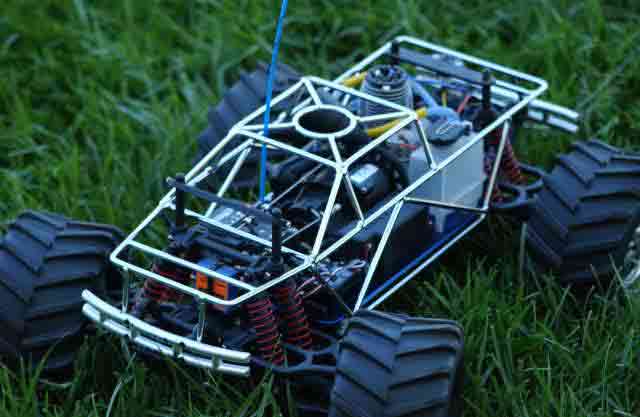
Above is a picture of it. It is hard to tell how it mounts onto it but you take the bumper off the front and the back and it fits into the grooves that are already there. It takes about 5 minutes to install it. I took a jump where I jumped all the way across a road and it landed on the back. It was a hard hit and the only thing that took any damage was the plastic cover.”
3D CSS Box Model and other CSS Links
Posted by Keith Elder | Posted in Internet, Programming | Posted on 24-05-2004
So I’ve been doing a lot of playing with CSS (Cascading Style Sheets) lately. I stumbled upon a really good article or two that helps makes more sense out of it a bit.
I found a really good article which outlines some nice tips to scaling PHP. The article is written by George Schlossnagle. In his article he explains why you do not need large DB abstraction layers like PEAR and ADODB and why you should NEVER use relative paths to images. The article can be found here.
P-P-P-powerbook (ebay seller scamming the scammer)
Posted by Keith Elder | Posted in Computer Hardware, Funny Stuff, Internet | Posted on 16-05-2004
I feel sorry for people that sell and buy on Ebay that do not have a working knowledge of the Internet in order to spot a scam. Luckily for this one person, they pulled one of the best documented pranks ever on a scammer on Ebay. It is completely documented with details of what happened. I started reading it, and fell in the floor.
Raid MySQL Tables
Posted by Keith Elder | Posted in Linux, Open Source, PC Software, Programming | Posted on 15-05-2004
The following was taken from Linux Magazine from an article written by Jeremy Zawodny. It talks about a litlte known feature of the MyISAM tables in MySQL which allows you to create raid tables. The snippet of the article is publised below.
RAID Tables The final variety of MyISAM tables isn’t widely known, but can be useful in some circumstances. RAID tables are simply MyISAM tables whose data (.MYD) files have been broken into multiple files. CREATE TABLE mytable … TYPE=MyISAM RAID_TYPE=STRIPED RAID_CHUNKS=4 RAID_CHUNKSIZE=8 Running that SQL command breaks the MyISAM table into 4 separate files (chunks) that are written to in a round-robin fashion in 8 KB stripes. Why do that? If you’re using a filesystem that places a limit on how large a file can be (2 GB or 4 GB), RAID tables work around that limitation. (However, file size limits are becoming more and more rare, as recent Linux kernels don’t have size limits anywhere near that low.) Performance is another reason for RAID tables. By putting each chunk on a separate physical disk, you can spread the I/O work out more evenly. In most MySQL installations, the main bottleneck is disk I/O, so this isn’t very far fetched. However, if you have the option of using hardware RAID or even software RAID at the OS level, you’re probably better off doing so.
Reference: LAMP Post, by Jeremy Zawodny